Snippets of Information - Inventions / Innovations
* 31 Oct 2026

Image: theearthprize.org
Three teenagers from Indore have developed a portable cooling device
that uses salt and water to keep vaccines and other
temperature-sensitive medical supplies cold without electricity,
batteries or ice. Their invention, Thermavault, won the Asia
category of the 2025 Earth Prize and secured $12,500 in funding to
support further development and testing. The Earth Prize is an
environmental competition for teenagers that
recognises projects addressing environmental challenges, with winners
selected from different world regions.
Dhruv Chaudhary, Mithran Ladhania and Mridul Jain, who were aged
16 and 17 when they developed the device, drew inspiration from
difficulties their parents, all medical professionals, encountered
during the COVID-19 pandemic. Rural healthcare facilities with
unreliable electricity often struggled to maintain the temperatures
required to store vaccines, leaving a gap between the availability of
medical supplies and their delivery to communities.
Certain salts absorb energy from their surroundings as they dissolve,
producing a cooling effect. The teenagers initially researched around
150 salts online before narrowing the list to approximately 20
candidates for further experiments.
A teacher eventually directed them towards two chemicals mentioned in a
ninth-grade science textbook: barium hydroxide octahydrate and ammonium
chloride. The combination provided the cooling effect they were seeking.
The teenagers developed a working prototype within three months of
identifying the formula. They then began testing the device at hospitals
around Indore.
The team plans to use part of the funding to pursue Performance, Quality
and Safety (PQS) certification through the World Health Organization
(WHO). Such certification could help the teenagers present Thermavault
to Gavi, the international alliance that supports vaccine distribution
and immunisation programmes worldwide.
Source: No electricity, no batteries: Meet the 3 Indian teenagers
who built a fridge powered by salt and water by Sheetal Kumari, 29 Oct
2026, moneycontrol.com
* 30 Oct 2026
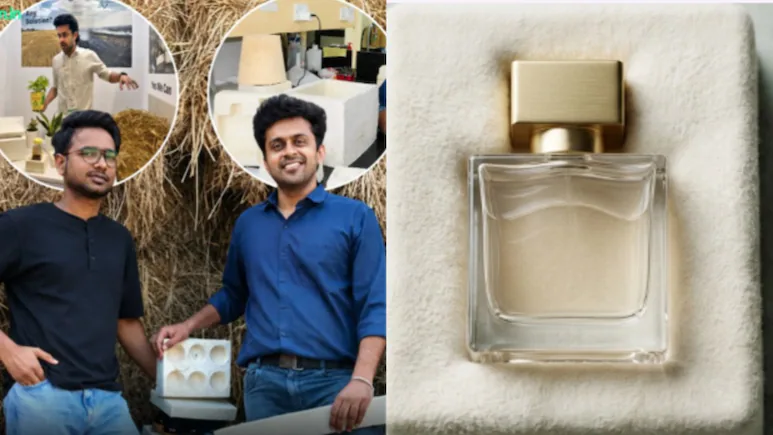
Image: Dharaksha Ecosolutions Website
Every winter, North India chokes on smoke from burning crop stubble.
Every day, mountains of thermocol packaging head to landfill. Founder
Arpit Dhupar built Dharaksha to solve both with one material.
A proprietary biotechnology process - incubated at the Regional Centre
for Biotechnology - turns crop residue into a high-performance,
biodegradable material grown with mycelium. Today it runs on a
closed-loop, automated production line in Faridabad.
Source: dharaksha.com
Delhi and surrounding areas face severe air pollution every year,
especially during winter, due to stubble burning. Seeing this year after
year, two entrepreneurs from Haryana have decided to turn that paddy
straw into a business.
Anand Bodh and Arpit Dhupar, who studied engineering at IIT, have
developed a way to turn paddy straw, commonly known as parali, into
packaging material that works like thermocol but decomposes naturally in
about 60 days. The business reportedly generates an annual turnover of
around Rs 2.5 crore.
The two entrepreneurs founded Dharaksha Ecosolutions in 2020 to
turn paddy stubble into biodegradable packaging. The name Dharaksha
comes from two Hindi words: 'Dhara', meaning earth, and 'Raksha',
meaning protection.
The company uses mycelium, the root-like network of a mushroom, to convert paddy straw into packaging material.
The process starts with collecting paddy straw from farmers in Punjab
and Haryana. The company works with aggregators who collect and compress
the straw into bales. The collected material is then chopped, steamed
and processed. The mushroom mycelium is introduced to the prepared straw
which allows it to grow through the material and form a solid
structure. The process can take up to 10 days, according to the
YourStory report. Dharaksha has also developed its own mushroom strain
for this process. Dhupar told YourStory that commercially available
mushroom strains did not have the qualities required to make its
packaging material.
Dharaksha's packaging decomposes in around 60 days under normal soil
conditions, according to the company. The material also has a reported
shelf life of more than three years.
Source: Instead of burning paddy straw, these IIT graduates
turned it into a crore-rupee business, ndtvprofit.com
* 15 Jun 2026
Researchers at IIT Bombay have developed a patented biomass gasification technology
that converts campus waste (dry leaves, twigs, and municipal solid
waste) into clean-burning cooking fuel. This homegrown innovation
drastically cuts reliance on LPG, achieving 60% thermal efficiency while
keeping emissions safely under 20 ppm.
The technology tackles the typical Indian biomass challenge (ash
clinkers and heavy smoke) through a carefully controlled, 4-step
sequence:
Collection & Pelletisation: Fallen leaves and twigs are gathered
from the campus. They are shredded, dried to remove moisture, and
compressed into dense, manageable biomass pellets.
Heating & Pyrolysis: These pellets are fed into a modified downdraft
gasifier. In a low-oxygen chamber, the biomass is heated to high
temperatures, triggering pyrolysis where the solid material releases a
fuel-rich gas.
Gas Cleaning: A patented premix burner system separates the particulate
matter and ash, eliminating the prolonged smoke emission seen in older,
conventional setups.
Combustion: The resulting producer gas (with a calorific value of 3.67
MJ/kg) provides a clean, steady, and smokeless flame perfect for
industrial canteen operations.
Source: Google AI overview (Industrial Research And Consultancy Centre, oil-gasportal.com)
|