STATES AND UNION TERRITORIES OF INDIA
TAMIL NADU - Info / Snippets
* 2 May 2026
A Tamil trader Cikai Korran who travelled to Egypt around
2,000 years ago carved his name inside the rock-cut tombs of Egyptian
pharaohs in the Valley of Kings, and the markings have now been
identified by Swiss scholar Ingo Strauch. The Tamil Brahmi inscriptions,
found in eight places across five of the six tombs dated to 1600 BCE,
offer fresh proof that ancient trade between India and the West was not
one-sided but involved long journeys and extended stays.
The name, "Cikai Korran", remained unnoticed for centuries until Strauch
and Charlotte Schmid from École Française d'Extrême-Orient (EFEO), or
the French School of Asian Studies, deciphered it and presented their
findings at a Tamil epigraphy conference in Chennai
Source: Tamil trader's name Cikai Korran found inside
2,000-year-old Egyptian Pharaohs' tombs: Study, The Economic Times
Online, 12 Feb 2026
* 2 May 2026
Pamban Bridges

The old Pamban Railway Bridge (1914 - 2026) was permanently
closed to rail traffic in December 2022 after structural cracks were
identified. While it occasionally serviced cargo prior to its
retirement, the 111-year-old structure was fully replaced by a new
vertical-lift bridge, with dismantling of the old span starting in early
2026. Train services were discontinued in December 2022 after safety
concerns. The 143-pier bridge survived for over 100 years, including the
1964 cyclone, but corrosion necessitated its replacement.
A new vertical-lift bridge - the New Pamban Bridge, was constructed alongside it and opened in 2025 to carry traffic between Mandapam and Rameswaram.
A vertical-lift railway sea bridge is a special kind of bridge that can
lift up in the middle, just like an elevator going up, so the boats can
safely go underneath it. Once the boat passes, the bridge comes back
down so the train can continue its journey. It’s a moving bridge that
helps both trains and boats go their way without getting in each other’s
path.
The Pamban Road Bridge or Annai Indira Gandhi Road Bridge is a 2.34 km long structure inaugurated in 1988. It connects National Highway 49 to Rameswaram Island in Tamil Nadu over the Palk Strait ...Read more at india-info.org
* 26 Mar 2026
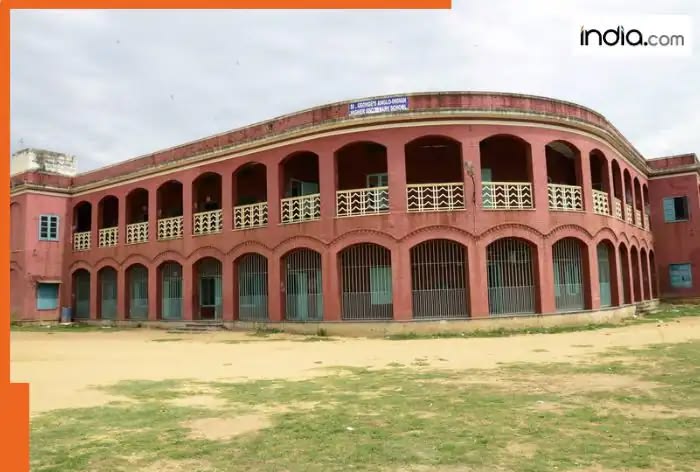
Image Source: india.com
St. George's Anglo-Indian Higher Secondary School in Chennai is considered India's oldest school,
established in 1715 by Rev. William Stevenson, the chaplain of St.
Mary’s Church, Fort St. George as the Military Male Orphan Asylum.
Located in Shenoy Nagar operating out of a historic 21-acre
campus, it initially served only British children and those of East
India Company officials ( to provide education for orphans of European
soldiers), denying admission to Indians during early British rule.
Today, it is a co-educational institution providing education from
nursery to Class 12, affiliated with the Anglo-Indian Board of
Education. The school is renowned for its long history and has a,
library that still contains books from the 18th century.
The chapel and the classroom block of St George’s Anglo Indian Higher
Secondary School are included in the list of CMDA’s (Chennai
Metropolitan Development Authority) 400 heritage structures in the city
of Chennai.
Sources: News18 and India.Com
Founded in 1715 by Rev. William Stevenson, the chaplain of St.
Mary’s Church, Fort St. George, the school traces its origin to St.
Mary’s Church Charity School that was started by him. The school was the
first to be founded by the Church of England in India with 30 children.
In 1917, it was joined with male and female orphan asylums and moved to
the Old Redoubt. As the school strength grew to 75 boys and 65 girls
from the orphanages, in 1867, it was shifted to where the present Egmore
Railway Station stands. However, with the expansion of the railway
station, the school moved to its current site in Shenoy Nagar. It was
renamed St. George’s School and Orphanage in 1954.
Source: The Hindu
|